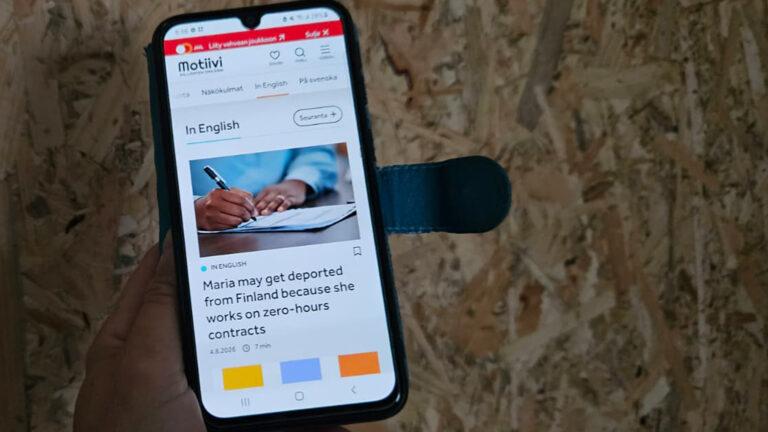
Maria, 28, lives in prolonged uncertainty. In the worst case, she may be deported from Finland.
Maria moved to Finland from Ethiopia in 2024. She works as a personal assistant for people with disabilities in the Helsinki Metropolitan Area.
Maria’s monthly income is regularly higher than €1600, which is the minimum that the Finnish Immigration Service Migri requires as a condition for granting a residence permit.
The income limit must be reached either in one regular job or several regular part-time jobs. The income is calculated from the hourly wage, excluding extra pay for Sunday work and other supplements.
The reason why Maria is at risk of being deported is that she works on zero-hours contracts, meaning that she is called to work when needed. Migri’s Process Specialist Veera Salminen explains by e-mail that this type of employment contract does not meet the requirements of a residence permit for an employed person.
“The Finnish Immigration Service cannot grant a residence permit if the employer cannot guarantee working hours and pay that meet the requirements of the residence permit”, Salminen writes.
This applies to both first residence permit applications and extended permit applications.
“This situation is really wearing me down”
Maria has ended up in her current situation unintentionally. She came to Finland thinking that she would get a permanent job in the care sector, qualify as a nurse and settle in the country.
In Ethiopia Maria got training for care sector work and worked as a nurse at a hospital. She heard from friends working in the care sector that there was work available in a remote country called Finland. That was all she knew about Finland.

Before departing to Finland, Maria made a three years long fixed-term contract with a Finnish employer. She was granted a residence permit for an employed person for one year based on that contract.
However, the employer cancelled the contract before Maria’s work started, and Maria, who had already arrived in Finland, was left with nothing. Since then, she has been working for different employers on zero-hours contracts.
Now Maria’s first residence permit has expired, and she is waiting for Migri’s decision.
Maria cannot make plans for the future. The long permit process burdens her everyday life, and uncertainty takes a toll on her well-being. At the moment, the average processing time of extended residence permits is 77 days.
At the moment, the average processing time of extended residence permits is 77 days.
Maria works for three employers, and her working hours regularly exceed 100 hours per month. She has delivered pay slips and a testimonial signed by her employer to Migri.
“This situation is really wearing me down”, Maria says.
She has studied Finnish in her own time at her own expense alongside work. Because Maria’s residence permit process is pending, she does not have a right to participate in integration training.
Maria answers questions in English. She explains that she has learned enough Finnish to be able to work. She thinks that she needs to learn more in order to be able to study and to handle everyday situations.
“Finnish is a difficult language.”
Negative residence permit decisions that are attributable to the employer have increased
Employers often offer only zero-hours contracts to immigrants working in the care sector, says Trade Union JHL’s immigrant activities specialist Linda Savonen.
According to Savonen, Migri has not informed clearly enough that a zero-hours contract is not sufficient for a residence permit. Migri’s income requirement page has a link to page Residence permit for an employed person. On that page Migri states that a zero-hours contract does not meet the requirements for granting a residence permit.
Savonen tells that cases similar to Maria’s experience have come to publicity when large numbers of immigrants who have been recruited to the social welfare and health care sector have lost their jobs.
“People who have come to Finland have been granted a residence permit for an employed person, but then the employer has cancelled the work that the person came here to do.”
This can be seen in the increased number of negative residence permit decisions. Last year, 39% of all negative residence permit decisions were attributable to the employer. This is an unfair situation for those who come to Finland. The applicant pays a processing fee of €750 before arriving in Finland, with money that they have earned in their country of departure.
Savonen tells that people have also come to Finland to study and get a vocational qualification degree. Many plan to become practical nurses or care assistants. Migri grants them a residence permit for studies.
“When they transition into working life, they may not know that zero-hours contracts or framework agreements do not qualify them for an extended residence permit”, Savonen says.
Immigrants are vulnerable to abuse
Grace Njue, age 37, works as a care assistant. She came to Finland from her native country Kenya in March 2024. Now Njue lives in Savonlinna. She studies alongside work to become a practical nurse and will graduate in the end of the year.

Njue has been a regional union representative for two months. She knows that things have become difficult for some of her friends and colleagues. The labour market situation in the social welfare and health care sector has declined. The Finnish Government increased the minimum income requirement for a residence permit for an employed person from €1399 to €1600 at the beginning of the year 2025.
Earlier, zero-hours contracts were not mentioned in the conditions of a residence permit.
Njue warns that a zero-hours contract is bad for an immigrant.
READ MORE: Work for immigrant equality took a leap forward – Here’s how you can get involved in the operations
If employment of a person who has moved to Finland based on a residence permit for an employed person ends, they have a three-month long protection period for finding a new job. For those who have been working for over two years, the protection period is six months.
In her capacity as a regional union representative, Njue has reviewed her own and her colleagues’ work shifts, contracts and accumulation of holidays more carefully than before.
“Those who come from abroad may not know the law and are susceptible to exploitation, such as overworking.”
Maria’s name has been changed due to the sensitive nature of her situation. Her identity is known to the editorial team.
The article was translated from Finnish by Sirpa Venäläinen.
What do framework agreement and zero-hours contract mean?
Framework agreement
- In a framework agreement the employee and the employer agree on terms and conditions that will apply in fixed-term employment contracts.
- Each individual work gig has to be agreed separately. A framework agreement alone does not guarantee any working hours.
- Each work gig is a new fixed-term employment relationship. The employee does not have an employment relationship with the employer between work shifts.
- A framework agreement is mainly suitable for occasional gig work, not for working regularly for the same employer.
- In Finnish, a framework agreement can be called runkosopimus, puitesopimus or aiesopimus.
A zero-hours contract (variable working hours contract)
- A zero-hours contract is an employment contract that does not obligate the employer to offer any working hours.
- From the legal perspective, zero-hours contracts are a type of variable working hours contracts.
- A zero-hours contract forms one continuous employment relationship.
- If an employee is called in to work as needed, that is also a zero-hours contract.
- A variable working hours contract can also specify for example that the weekly working time is 10–40 hours. In this case, the minimum weekly working time is ten hours.